
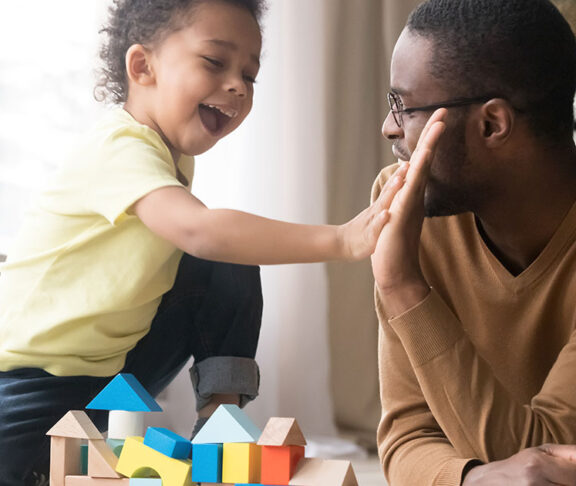
The activities that best prepare children for kindergarten look far less like worksheets and far more like everyday play.

Erica Holmes-Ware, Ed.D.
Chief Program Officer, Children’s Literacy Initiative
A recent longitudinal study published in the Journal of Speech, Language, and Hearing Research found that children’s growth in oral language during preschool predicted both kindergarten readiness and later third-grade reading achievement, reinforcing what educators have long understood: the conversations, stories, songs, and playful interactions children experience before kindergarten lay the groundwork for future literacy success.
Why play beats flashcards
When parents think about preparing their children for kindergarten, it’s easy to picture alphabet flashcards, handwriting practice, or counting worksheets. While those methods certainly have their place, one of the most important things families can do before kindergarten looks a lot more like play.
Long before children read words independently, they are building the language, curiosity, and confidence that make reading possible. Every conversation, question, story, and playful moment helps lay the foundation for future literacy.
Dramatic play builds vocabulary
Dramatic play is one of the richest opportunities for language development. Whether children are pretending to run a grocery store, care for stuffed animals, or serve dinner in an imaginary restaurant, they are learning new vocabulary, practicing conversations, and developing the ability to tell stories. As adults join the play by asking questions and introducing new words, children’s language grows naturally.
Blocks teach children to sequence
Building with blocks offers more than an introduction to shapes and engineering. As children plan what to build, explain their ideas, and describe what happens when their tower tumbles or their bridge connects, they learn to sequence events and organize their thinking — important skills for both storytelling and reading comprehension.
Drawing invites children to explain
Creative activities like drawing, painting, and crafting encourage children to express ideas before they can write them. Answering questions like, “Tell me about your picture,” gives children opportunities to expand their vocabulary and organize their thoughts, strengthening the oral language that supports later reading and writing.
Music strengthens sound awareness
Music also plays an important role in literacy development. Singing songs, clapping rhythms, and reciting nursery rhymes help children hear the sounds within words, an essential building block for learning to read. These joyful experiences strengthen phonological awareness while making language memorable and fun.
Nothing replaces sharing books together
Of course, there is no substitute for sharing books together. Reading aloud introduces children to new vocabulary, expands their understanding of the world, and creates opportunities to wonder, predict, and ask questions. The conversation before, during, and after the story is often just as valuable as the story itself.
These everyday interactions are part of a child’s literacy ecosystem, where families, educators, communities, and, eventually, schools work together to nurture language, curiosity, and confidence long before formal reading instruction begins.
The best kindergarten readiness activities don’t feel like preparation at all; they feel like childhood, filled with conversation, imagination, discovery, and joy. When families, educators, and communities work together to create these experiences, we build the foundation every child deserves. Investing in early literacy isn’t simply about preparing children for kindergarten; it’s about opening the door to a lifetime of reading, learning, and possibility.
