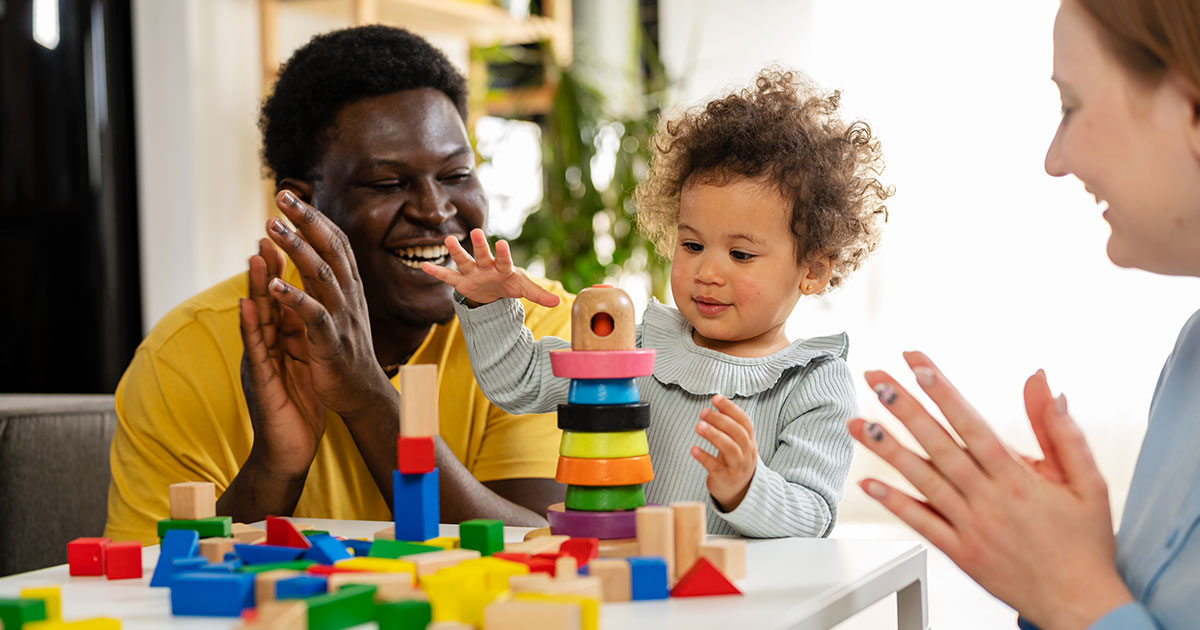
When children play with open-ended materials like blocks, they build the language and math skills that support later learning.

Susan Friedman
Senior Director of Publishing and Content Development, National Association for the Education of Young Children
I’m obsessed with wooden building blocks, so much so that I sometimes wait to give baby gifts until children are a year old, when giving a set of wooden building blocks seems less ridiculous. Why the obsession? Blocks are a fantastic open-ended material that children can use and turn into whatever is in their imagination. As children develop, their play with blocks develops as well. A toddler can stack them and knock them down, 4-year-olds can build a bed and car for their babies, and 7-year-old friends can construct a fantasy city they’ll rebuild and play with for hours on end.
Blocks also offer opportunities for children to conceptually explore mathematical principles such as measurement, counting, and fractions as they play. As they build, children notice, “Oh, here’s a long block, and it takes two of these medium-sized blocks or eight of these smaller blocks to equal the length of this longer block.”
Many more materials to explore
Blocks are not the only toys that offer children great learning opportunities. Endless more are described in the National Association for the Education of Young Children’s book “Preschoolers at Play: Choosing the Right Stuff for Learning and Development,” by Lisa Mufson Bresson and Megan King. This book highlights not just toys but also other materials children can play with, such as everyday kitchen tools. It also outlines how the toy or “play material” supports children’s development and learning. Here’s just a small selection described in this book:
| Suggested play materials | Supports learning in this area |
| 1. Magnetic boards and letter magnets | Identifying letters and their sounds |
| 2. Chalkboards, chalk, and writing tools of various thicknesses (e.g., crayons, colored pencils, pens, markers) | Writing and print awareness |
| 3. Books 4. Felt board and felt pieces 5. Puppets | Storytelling, listening, and comprehension |
| 6. Blocks and other building toys in a variety of sizes, shapes, and materials (e.g., bristle blocks, Duplo blocks) | Geometry, shapes, and spatial sense; building and engineering |
| 7. Measuring tools (e.g., measuring cups and spoons, measuring tapes, rulers) | Measurement |
| 8. Dice or dominoes with numerals, dots, or algebraic symbols on their faces 9. Peg boards with numbers on them and holes that match the quantity 10. Playing cards | Number sense and counting |
| 11. Natural materials (e.g., pinecones, sticks) 12. Small, realistically proportioned animal figures 13. Magnets | Nature and scientific inquiry; creative problem solving |
| 14. Board and card games that require two or more players (e.g., Candy Land, Chutes and Ladders, Jenga, Memory Match, Slapjack, Uno) | Cooperation, turn-taking, negotiating, and compromising |
| 15. Dolls, soft puppets, and stuffed animals 16. Sensory materials that respond to touch (e.g., clay, sand, soil, water) 17. Yoga pose cards and mat | Recognizing, labeling, and acting out emotions |
| 18. Drawing and painting materials of varying thicknesses 19. Glue bottles and sticks, paste, and tape 20. Modeling dough and clay | Creative expression, visual arts, and fine motor skills |
| 21. Percussion instruments | Making music |
| 22. Dolls and doll accessories 23. Dress-up clothing and accessories and items for dramatic play (e.g., hats, oven mitts, pots, and pans) | Pretend play |
| 24. Hula-Hoop 25. Jump rope 26. Materials for pushing, pulling, or transporting (e.g., wagons, laundry baskets) 27. Balls of assorted sizes and weights | Gross motor skills |
| 28. Building toys to connect and take apart 29. Tools that require gripping or squeezing (e.g., scissors, spray bottles, tongs, turkey basters) 30. Lacing cards | Fine motor skills |
