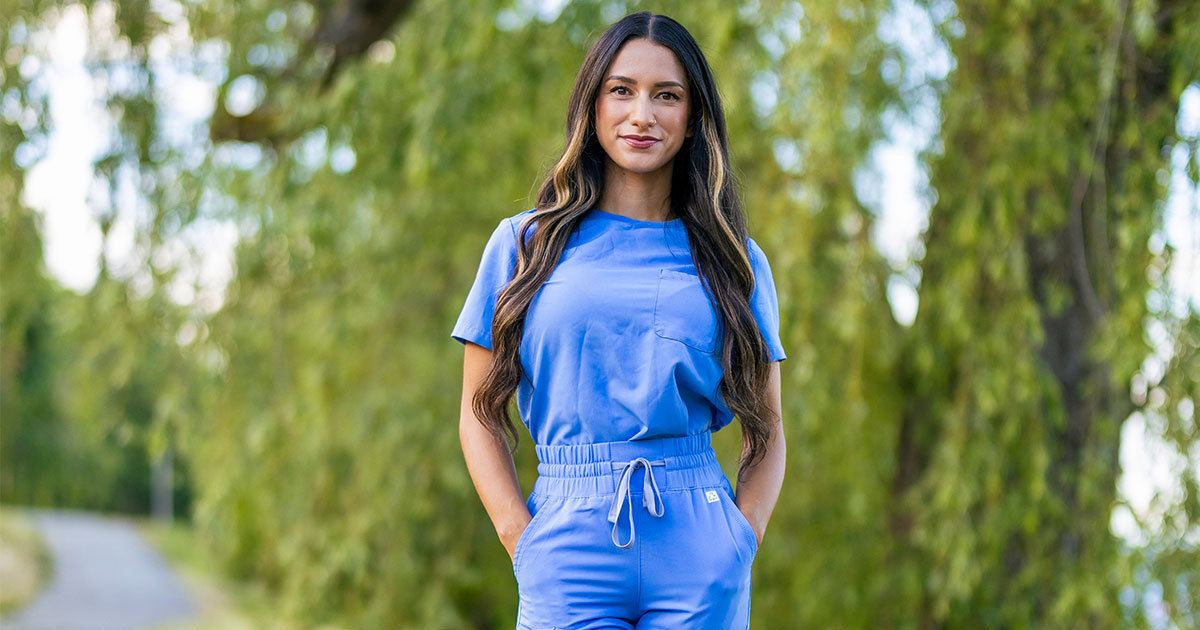
Deaf registered nurse and content creator Mikaela Thepvongsa discusses the work of advocating for access at every step.
How have you learned to advocate for yourself as a deaf nurse in clinical settings?
I got sick as a baby, and by the time I did my final hearing test around age 2 or 3, the results found that I was deaf. I wore hearing aids as a young child, but they didn’t help me understand speech. Getting my cochlear implant at 10 years old changed everything. Because I’ve lived with disability and chronic medical conditions my whole life, I learned early on that the world wasn’t built for someone like me, and that if I wanted to succeed and thrive, I had to advocate for myself.
My needs have changed throughout my life, which meant my advocacy had to evolve, too. I started nursing school in January 2020, a couple of months before the pandemic hit. Suddenly, everyone was masked, and I could no longer read lips, which was something I never predicted would be taken away from me. I had to figure out access all over again, in real time, during one of the hardest moments in healthcare history.
Sometimes advocacy starts before the job even does. At my first hospital job, I was told I couldn’t begin the accommodations process until my official start date, and I had to push back on that. From there, advocacy became a daily practice, and it still is. During the pandemic, I asked coworkers to wear clear masks. I use closed-loop communication, repeating back what was heard so everyone is on the same page. I sometimes use a mini microphone that streams sound directly to my cochlear implant, which is especially helpful during report. Since my cochlear implant has Bluetooth capabilities, phone call audio streams directly to my device while I follow along with closed captioning.
People often assume accommodations mean someone can get out of doing certain skills or tasks, but that’s not true. I still answer phone calls, I still listen to heart sounds, and I still do the same tasks as every other nurse. I just had to find different ways to accomplish them. The other reality is that I’ve largely had to figure it all out alone. I researched the stethoscopes, the clear masks, and the captioning apps. I’m the one who brings the companies, tools, and services to my employers, not the other way around. That was exhausting, but it made me an expert in my own access, and now I get to pass that knowledge on so other deaf and disabled healthcare workers don’t have to start from zero like I did.
What contributes most to your burnout as a nurse?
A lot of things. Our system simply doesn’t provide enough resources or support for nurses in general, let alone new graduate nurses, and especially not new graduate nurses with disabilities. What contributed most to my burnout was having to work harder than everyone else just to be seen as equal. I was held to a higher standard, and I knew it.
In my first year as a new graduate nurse, I was the only one in my nurse residency cohort to pass the National Council Licensing Examination on the first try. I co-authored an academic nursing article. I enrolled in a critical care continuing education course. I received multiple excellence awards from patients and their families. I did all of that while learning to be a new intensive care unit (ICU) nurse on night shift, working part-time home health, and creating disability advocacy and education content on my social media platforms. Despite the extra work I put in, I wasn’t given the same grace as the other new nurses.
There’s a reason “nurses eat their young” has been a saying for generations, and for me it was compounded by my disability. Other nurses joked about my hearing devices behind my back. At one point, I was even written up over a hearsay claim that my cochlear implant had died during my shift, which never happened. I was constantly explaining how I do my job, like how my amplified digital Bluetooth stethoscope works, while no other nurse gets asked if they own a stethoscope or how they use it.
There was also invisible labor that no one saw. Other nurses could roll out of bed, and if they forgot their stethoscope, they could borrow one from a coworker. I couldn’t. My stethoscope cost several hundred dollars, I had to keep it charged myself, and I carried a backup just in case. The work followed me home, too. I would ask my mentors how to pronounce certain medications and medical terms, because I don’t pick up pronunciation naturally just by hearing it the way hearing people do. I was carrying all of this at once, and it came at the expense of my own health. I had no time to go to my doctor appointments because I was always working. I was sick all the time.
Burnout isn’t a personal failing. It’s what happens when the system asks certain people to carry twice the load with half the support. Acknowledging that is the first step toward fixing it.
What has helped you succeed most in your nursing career so far?
Despite everything, it’s the people I’ve met along the way. Because I wasn’t getting adequate support where I was, I had to go find it elsewhere. It started when I was a senior nursing student sharing my experiences on social media. I wanted to show people what daily life with a disability actually looks like. This platform is how I found my community. Through it, I connected with mentors who answered my questions when people on my own unit wouldn’t, and with other disabled healthcare workers across the entire spectrum, from students to surgeons with decades of experience.
The visibility went both ways. Parents, students, and families have reached out to tell me my story inspired them to go to nursing school, to learn American Sign Language (ASL), or to support someone in their life differently. I’ve received excellence awards and letters from patients and their families about the impact I had on them and their care, and I’ve kept every single letter. When the system fails you, people can still carry you. That connection is what keeps me going.
Where do you see the biggest opportunity for healthcare systems to better support nurses today?
This is a systemic issue that will take real work and real time, but I believe it starts with education, awareness, and a culture of acknowledgment. We simply don’t support nurses enough, whether they’re new grads or nurses with decades of experience. The pay, the unsafe staffing ratios, the lack of standardized protocols nationwide — healthcare systems need to be held accountable and be willing to admit “we can do better,” because there is always room for improvement.
I know what better looks like because I’m living it now. At my current job, my coworkers advocated for me to have enough orientation time with all of my accommodations actually in place, because accommodations take time to set up. When our all-staff celebration was coming up, a coworker who knew me asked my manager about requesting an ASL interpreter, and my manager did exactly the right thing: She came to me first and asked whether that was something I wanted. My team has always been receptive to my accommodations, whether that was wearing clear face masks or me using my mini microphone in staff meetings. Every single preceptor I’ve had here asked real questions about how to best help me. I still receive honest, critical feedback, but it comes from a place of investment, not judgment. My accommodations aren’t something I have to chase down alone anymore. Other people are involved and want to see the process through.
None of that required a policy overhaul. It required people who cared and a culture that let them. The biggest difference between my first job and my current job is the support around me.
What would meaningful change look like for nurses like you in the healthcare system?
It starts where nursing starts: nursing school. Nursing school is known for being tough, which is fine, because it should prepare you for a demanding career. However, too many programs confuse being tough with being unsupportive. Some don’t teach essential topics, don’t provide accommodations, don’t offer enough clinical hours, or have professors who are more interested in looking down on students than teaching them. Meaningful change means building support and encouragement into the profession from day one, so nurses enter the field prepared and confident instead of already worn down. If we build a strong foundation, everything from there improves, including patient care.
What tools or accommodations make the biggest difference in your day-to-day work?
My cochlear implant is the most important tool I have. Without it, I can’t hear at all. With it, I can. The audio from my amplified digital Bluetooth stethoscope streams directly to my implant, which lets me auscultate heart sounds and lung sounds. I sometimes use a mini microphone for meetings, and I always use a captioning relay app for phone calls.
However, it’s important to understand that the tools are only half of it. The other half is the work nobody sees. Many people don’t realize that I don’t learn sounds naturally. In order to understand a sound, I first have to identify it. At my first hospital job, I spent countless hours at home training myself on the different alarm sounds, playing them over and over until I knew each one. After more than a decade of not wearing a hearing aid in my left ear, I went out of my way to see an audiologist and get fitted for one again, just so I could pick up extra sounds I might have otherwise missed. It wasn’t comfortable, it was incredibly expensive, and I had to retrain my left ear from scratch. Nobody asked me to do that. I did it because that’s the level of dedication I bring to my work and to keeping my patients safe.
That’s what I want people to understand about accommodations. They aren’t shortcuts or special treatment; they’re tools that help close the gap for people at a disadvantage. Even with accommodations, we often still have to put in extra work. Regardless, everyone needs support. That support just looks different for everyone, and it needs to be equitable.
What keeps you motivated to stay in nursing despite the challenges the profession faces?
Hope. The hope that it gets better, and that future nurses won’t have to go through what I did, what we did. I left the ICU after a year and a half, but I didn’t leave nursing. Since then, I’ve worked in home health, as a festival safety team nurse, as a summer camp nurse, and in community health. Today, I work as a nurse at a federally qualified community health center serving marginalized populations, alongside various per diem, or as-needed, nursing roles. I really enjoy making a positive impact on patients’ lives, and that’s something I want to keep doing.
I truly believe we can always do better, because nurses shouldn’t have to keep compromising our own sanity and safety just to help others. That’s why I’m sharing my story. I’m fighting for better, and I want people with disabilities to know there’s hope for them, too.
