
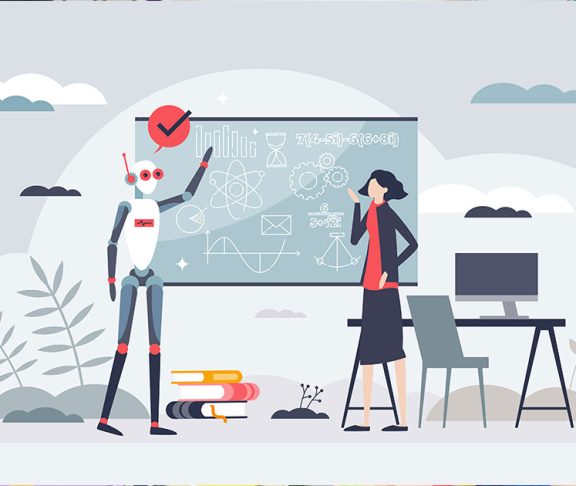
Artificial intelligence holds real promise for early childhood educators, but when it comes to our youngest and most at-risk children, it must be approached with caution.

Dr. Diana Greene
CEO, Children’s Literacy Initiative

Erica Holmes-Ware
CPO, Children’s Literacy Initiative

Reina Prowler
COO, Children’s Literacy Initiative
Artificial intelligence (AI) is rapidly becoming part of the educational landscape, including in early childhood classrooms. From generating lesson plans to offering individualized feedback for older children, AI tools hold real promise for educators who are navigating limited time, growing demands, and diverse student needs. For early childhood educators in particular, AI can increase accessibility for students, support differentiated instruction, and free up teacher time for what matters most: meaningful, responsive interactions with young learners.
However, when it comes to our youngest and most at-risk children, the use of AI must be approached with caution. AI is not neutral, and its limitations — especially related to bias and misinformation — can have serious consequences if left unexamined.
The problem of bias
One major concern is bias. As Walden University notes, AI systems are only as good as the data they are trained on. If that data reflects existing societal biases, the AI’s outputs may reinforce stereotypes or perpetuate inequities. In education, this can show up in subtle but harmful ways: biased feedback, inequitable assessments, or recommendations that fail to honor a child’s cultural background, language, or lived experience. For young children — particularly children of color, multilingual learners, and children from historically marginalized communities — these biases can compound existing disparities rather than reduce them.
Accuracy and misinformation
Another critical limitation is accuracy. AI tools can generate errors, outdated information, or outright misinformation. Because AI responses are often delivered confidently and fluently, there is a risk that educators or students may assume the information is correct when it is not. In early childhood education, where foundational skills and concepts are being formed, inaccurate information can undermine learning and trust. Teachers remain the essential interpreters, evaluators, and decision-makers when it comes to instructional quality.
The cultural responsiveness gap
These concerns are especially important when viewed through a culturally responsive lens. Research consistently shows that culturally responsive instruction is one of the most effective approaches in literacy education, with studies indicating gains of up to 15 percentile points in student achievement. Yet only about 20% of U.S. digital learning tools currently include culturally relevant content. This gap matters. When AI tools lack cultural responsiveness, they risk offering one-size-fits-all solutions that fail to reflect the identities, strengths, and communities of the children they serve.
Thoughtfully designed AI can help address this gap, but only if it is intentionally grounded in evidence-based, culturally responsive frameworks and paired with strong family engagement. Research shows that consistent parent and caregiver involvement significantly improves reading outcomes and persistence, reinforcing the idea that technology should support, not replace, human relationships and contextual knowledge.
Using AI responsibly
AI can and should be a helpful tool in early childhood education. But it must be used critically, transparently, and ethically. For educators, this means asking hard questions about whose knowledge is represented, how recommendations are generated, and whether a tool truly serves the best interests of young learners. When used thoughtfully, AI can support equity. When used carelessly, it risks deepening divides. Our responsibility is to ensure it does the former — especially for the children who need us most.
